
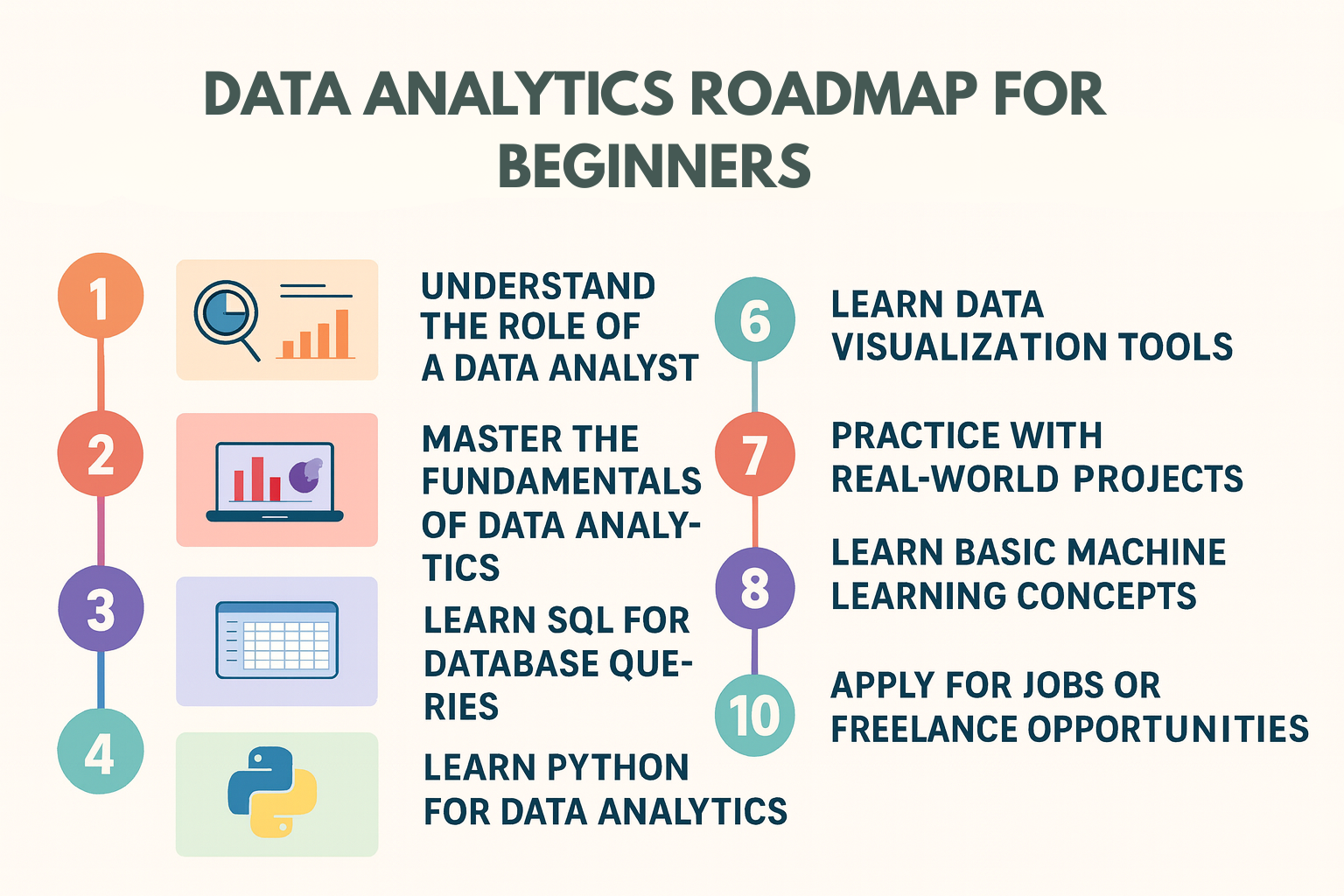
You may be asking what skills to study first, which tools to become proficient with, and how to start a data analytics career from scratch if you’re just getting started. Everything you need is broken down in this data analytics roadmap, from fundamental ideas to practical projects, certifications, and career paths.
This guide will provide you with a clear, practical plan whether your goal is to work as a data analyst, business intelligence professional, or even move into data science.
Why You Need a Data Analytics Roadmap
One of the skill sets with the fastest global growth is data analytics. Data is used by businesses of all sizes, from startups to large corporations, to make strategic choices. However, the lack of a systematic approach causes many novices to struggle. Without it, a plethora of tools, words, and strategies can quickly overwhelm you.
By outlining what you should study, in what order, and why, this roadmap makes the process easier.
1. Understand the Role of a Data Analyst
Before you start learning tools, you must understand what data analysts do:
-
Interpret and visualize data
-
Clean and organize large datasets
-
Build dashboards and reports
-
Identify patterns and trends
-
Help decision-makers with insights
This distinction is crucial since data analytics abilities incorporate critical thinking, communication, and domain knowledge in addition to being technical.
2. Master the Fundamentals of Data Analytics
Learn Basic Statistics and Mathematics
To perform meaningful analysis, you should understand:
-
Averages, medians, and variance
-
Probability basics
-
Hypothesis testing
-
Distribution
These foundations make it easier to evaluate trends and patterns.
3. Learn Excel or Spreadsheet Skills
Excel is often the first tool data beginners use. You should learn:
-
Pivot tables
-
Formulas (SUMIF, VLOOKUP, INDEX/MATCH)
-
Charts and conditional formatting
-
Data cleaning techniques
Even in advanced careers, Excel knowledge remains essential.
4. Learn SQL for Database Queries
The language used by databases is called SQL (Structured Query Language). SQL is used by data analysts to get and work with data from relational databases.
Start with:
-
SELECT statements
-
WHERE, JOIN, GROUP BY
-
Subqueries and functions
-
Aggregations and filtering
5. Learn Python for Data Analytics
One of the most important programming languages for contemporary data analysts is Python. Data cleaning, analysis, visualization, and even machine learning are all done using it.
At Zerotozenith Media, our hands-on Master Python Course is designed for beginners, no experience required.
Why Python Matters for Data Analytics
Python allows you to:
-
Load and clean datasets (Pandas)
-
Perform numerical computations (NumPy)
-
Create visualizations (Matplotlib, Seaborn)
-
Build automation scripts
-
Level up into AI, data science, or machine learning
This course teaches you core Python programming from scratch, so you can confidently use it in real data analytics projects.
6. Learn Data Visualization Tools
Visualizing data helps stakeholders understand insights quickly.
Top beginner-friendly visualization tools include:
-
Tableau
-
Power BI
-
Python libraries (Matplotlib, Seaborn)
Learn how to build dashboards and charts that tell a clear story.
7. Practice with Real-World Projects
Hands-on experience is the most effective way to learn. You should practice:
-
Cleaning messy datasets
-
Building dashboards
-
Writing data reports
-
Performing exploratory data analysis (EDA)
Use publicly available datasets like:
-
Kaggle datasets
-
Government open data portals
-
Company APIs
8. Learn Basic Machine Learning Concepts (Optional)
Once you’re comfortable with Python and analytics, consider learning:
-
Regression analysis
-
Classification models
-
Clustering
-
Model evaluation techniques
This will prepare you for advanced data science roles.
9. Build a Portfolio & Resume for Data Analytics Jobs
A strong portfolio sets you apart. Include:
- Project descriptions
- Visual dashboards
- Code samples (GitHub)
- SQL queries
- Reports with insights
A GitHub repository with real projects signals credibility to employers.
10. Apply for Jobs or Freelance Opportunities
Once you’ve built skills and a portfolio, start applying for:
-
Junior data analyst roles
-
Business intelligence assistant
-
Data reporting specialist
-
Freelance analytics projects
Platforms like LinkedIn, Indeed, and Upwork are great for job hunting.
What Tools Should Beginners Learn?
| Category | Tools |
|---|---|
| Spreadsheets | Excel, Google Sheets |
| Database | SQL |
| Programming | Python (Pandas, NumPy) |
| Visualization | Tableau, Power BI, Python (Seaborn) |
| Analytics Workflow | Jupyter Notebook, VS Code |
Your Data Analytics Journey Starts Here
Although entering the field of data analytics may seem intimidating, having a clear plan will help you stay intentional and focused.
Every stage, from studying Python and creating actual dashboards to becoming an expert in Excel and SQL, increases your self-assurance and abilities.
If you’re serious about launching a data career, don’t skip Python, and a structured course like the Zerototenith Media Master Python Course can accelerate your growth and prepare you for real analytics challenges.
The outcomes will speak for themselves if you begin your data analytics journey with practice, purpose, and the appropriate strategy.